Vineet Agrawal
Healthcare Innovation Leader • 1st
1/14/2025 • 4 min read
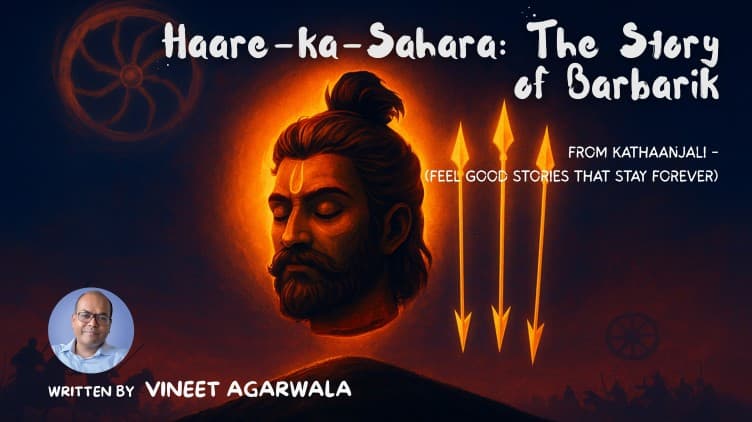
Haare-ka-Sahara: The Story of Barbarik
KathaAnjali is my personal archive of stories that hit deeper than advice.
Short, real, and rooted in Indian mythology, history, sport, and everyday life — each one is picked to make you pause, feel, or see differently
Some teach. Some heal. All stay.
Long before Kurukshetra thundered with conches and chariots, there lived a mighty rakshasa-prince named Ghatotkacha, son of Bhima and Hidimbi. In the far east, he married Maurvi (Ahilavati), the famed daughter of the asura Mura. Their child arrived like a streak of dawn—broad-chested, bright-eyed, crowned with bristling hair. Seeing those wild locks, Ghatotkacha named him Barbarik.
Barbarik grew up on two things—valour and values. His mother trained him in the arts of war and taught him the limits of power.
After a long tapasya to Agni Deva, Barbarik earned an invincible bow. Later, Lord Shiva blessed him with three unfailing arrows. Those arrows worked like a vow:
• one would mark what must be protected,
• one would mark what must be destroyed, and
• the third would finish the task and return.
People began to whisper a name that would follow him forever—Teen-Baan-Dhari, the bearer of three arrows.
When the news of the Mahabharata war spread, the young hero sought his mother’s permission to fight. As the war was between relatives, both sides were dear—so he asked, “Which side should I join?” His mother gave him a single, stern rule: “Stand with the weaker side.” Barbarik obeyed. In time he would be lovingly called haare-ka-sahara—shelter of the defeated.
On his way to Kurukshetra, Krishna came to test Barbarik, disguised as an old Brahmin. Under a peepal tree they spoke of war and justice.
“You are too young for a fearsome war,” the Brahmin said. “And you carry only three arrows?”
Barbarik calmly explained what his arrows could do.
“How quickly can you end the war?” the Brahmin asked.
Barbarik smiled: “One muhurta—a moment.”
(The same question had been asked of other warriors: Bhishma said 20 days, Dronacharya 25, Karna 24, and Arjuna 28. Yet Barbarik said—one moment.)
Almost in disbelief, the Brahmin asked for a demonstration. He told Barbarik to strike every leaf on the peepal tree—secretly hiding one leaf under his foot.
Barbarik released the first arrow; it marked every leaf in a blink with a white sign. The second arrow shot forth and began piercing the marked leaves one by one. Then it circled the Brahmin’s foot and hovered there.
“Please lift your foot,” said Barbarik. The Brahmin moved—and the arrow instantly struck the hidden leaf. The Brahmin noticed it was already marked.
Krishna understood: even if he tried to hide someone, Barbarik’s arrows would still find and strike.
Then came the true question:
“Whose side will you take?”
“The weaker,” Barbarik answered without thinking, proudly. At that moment it was the Pandavas—Bhima was his grandfather too.
The Brahmin shook his head and gently laid out the paradox:
“If you join the weaker, they will become stronger. Your vow will force you to switch sides again and again—till both armies are destroyed and only you remain.”
Barbarik understood. His promise—born of compassion—could burn the world.
Barbarik was torn. “What should I do?” he asked.
The Brahmin requested daan: “Give me your head.”
Barbarik looked up and saw through the disguise—it was Krishna. Krishna revealed his true form and said, “Before a dharma-yuddha begins, the greatest sacrifice must be offered.”
Without a second thought, Barbarik bowed. “If this saves Dharma, take it.” He had one wish: “Let me watch the greatest war.”
Krishna blessed him. The head was bathed in amrit and placed high on a hill overlooking Kurukshetra—and from there Barbarik saw everything.
Eighteen days later, when the dust settled, the Pandavas argued about who deserved the credit. Bhima thundered, Arjuna reasoned, Yudhishthira praised Krishna. Hearing the debate, Krishna said, “Ask the one who saw it all.”
They went to Barbarik’s head on the hill.
Barbarik said softly. “On the battlefield I saw only two powers at work. A divine Sudarshan chakra, spinning ceaselessly, cutting down all who stood against Dharma. And beside it, Goddess Mahakali, her vast tongue spread across the field, consuming the fallen sinners as her sacrifice.” Flowers fell; the brothers bowed. The witness said the victory belonged to Krishna.
Before they departed, Krishna granted a boon:
“In the age to come, people will call you Shyam—after my name—and they will remember you first when they feel defeated. You will be Haare-ka-Sahara.”
Time rolled on. Legends say Barbarik’s head was later found at Khatu in Rajasthan. A local ruler, Roop Singh Chauhan, dreamed of the buried head and built a shrine where it was found. That shrine became today’s Khatu Shyamji Temple, where millions still line up and whisper a simple prayer: “When I feel small, stand with me.”
If this story stirred something in you — drop a note.
Need your encouragement...
If you have a story, share it…