Vineet Agrawal
Healthcare Innovation Leader • 1st
1/14/2025 • 4 min read
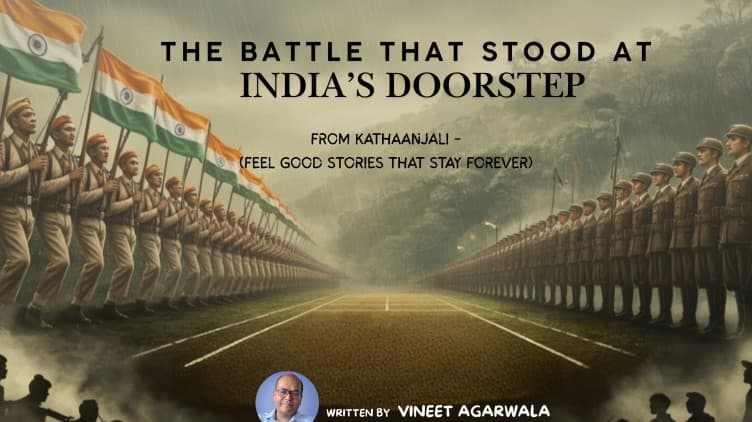
The Battle That Stood at India’s Doorstep
KathaAnjali is my personal archive of stories that hit deeper than advice.
Short, real, and rooted in Indian mythology, history, sport, and everyday life — each one is picked to make you pause, feel, or see differently
Some teach. Some heal. All stay.
The Untold Chapter of Kohima, 1944
It was April 1944
The hills of Kohima, draped in early monsoon mist, were calm — until the earth began to shake with artillery fire.
No one imagined that this remote ridge in Nagaland would soon become the stage for one of the most decisive — and tragic — battles ever fought on Indian soil.
The world remembers it as the Battle of Kohima
But for India, it was much more — a heartbreaking moment when Indians fought Indians, each believing they were serving the motherland.
The Call of Freedom
In the dense jungles of Burma, Netaji Subhas Chandra Bose had raised a new army — the Azad Hind Fauj (Indian National Army).
Supported by Japan, they marched under one cry:
“Dilli Chalo!” — “Let's march to Delhi”
Netaji’s belief was simple yet fierce — freedom would never be given; it had to be taken.
And the war in the East, he believed, was India’s moment to strike.
So when Japan launched Operation U-Go in 1944, the INA joined the campaign, crossing Burma with the dream of raising the tricolour in Delhi.
Their path to India ran through Imphal and Kohima — two small towns guarding the route to Assam and Bengal.
To them, Kohima was not just a ridge — it was the gateway home.
The Hills of Kohima
On the other side stood the British Indian Army, defending Kohima — ironically, with thousands of Indian soldiers in its ranks too.
Men from Punjab, Bihar, Assam, and Nepal — all fighting under a foreign flag, believing they were protecting their soil from invasion.
That was the tragic beauty of Kohima:
“Brothers born under the same sky, now divided by two destinies.”
By early April, Japanese and INA forces surrounded the ridge.
The defenders — just a few thousand — were cut off.
No food. No water. No reinforcements.
For days, they survived on whatever little they had — old biscuits, muddy rainwater, and faith.
The battle raged in impossible conditions.
The lines were so close that at one point, they fought across a tennis court, using its white lines as the front.
Every inch of ground was contested; every night echoed with the cries of the wounded.
Hunger and Heroism — The Legend of Badluram
Amid that siege, the Assam Regiment became a symbol of endurance.
And from their story was born a song that still lives on in army camps today —
“Badluram Ka Badan Zameen Ke Neeche Hai…”
Badluram was a soldier of the 1st Assam Regiment — brave, ordinary, and now immortal.
He was killed in an earlier battle, but his quartermaster, Subedar Kandarpa Rajbongshi, never struck his name off the ration rolls.
So when the siege began and supplies were cut off, the unit unknowingly had one extra soldier’s ration — month after month.
That food — meant for a man long gone — helped the living survive when the world above rained death
In those desperate nights, someone turned that dark irony into a song:
“Badluram ka badan zameen ke neeche hai,
Par humko uska ration milta hai.”
(“Badluram’s body lies beneath the earth,
But we still get his ration.”)
What began as gallows humour became a regimental anthem — a reminder that even in death, a soldier can feed life.
To this day, the Assam Regiment sings it with pride — every time they march, every time they remember Kohima.
The Cost and the Crossroads
By June 1944, the siege ended.
The Japanese and INA forces, starving and exhausted, retreated through the monsoon-soaked jungles of Burma.
Thousands died — of hunger, disease, and exhaustion.
The dream of “Dilli Chalo” was halted at the doorstep of India.
But history cannot measure courage by outcome alone.
The men who fought under Netaji’s flag did not fail — they planted the seed of rebellion that would soon shake the British Empire.
When the INA Trials began the next year in Delhi, millions rose in protest — for the first time, the entire nation’s heart beat as one.
The Whisper of Kohima
Today, at the Kohima War Cemetery, white gravestones line the old tennis court.
Among them stands an epitaph that has become immortal:
“When you go home, tell them of us and say,
For your tomorrow, we gave our today.”
But if you listen closely, perhaps the hills still hum that other tune —
of Badluram and his ration,
of hunger and humour,
of courage and comradeship that transcended flags.
Reflection
The Battle of Kohima was not about victory or defeat.
It was about conviction — the kind that made one man march to Delhi with a dream,
and another hold the line believing he was protecting home.
Both were Indians.
Both were patriots.
And both gave their today — for our tomorrow.
Because history is not about who won — it’s about who believed.
For me, Kohima isn’t just a war story — it’s a mirror of conviction, sacrifice, and the price of belief. Because sometimes, the bravest thing you can do is stand firm in what you believe is right… even when history can’t decide who truly won.
If this story stirred something in you — drop a note.
Need your encouragement...
If you have a story, share it…