Vineet Agrawal
Healthcare Innovation Leader • 1st
1/14/2025 • 4 min read
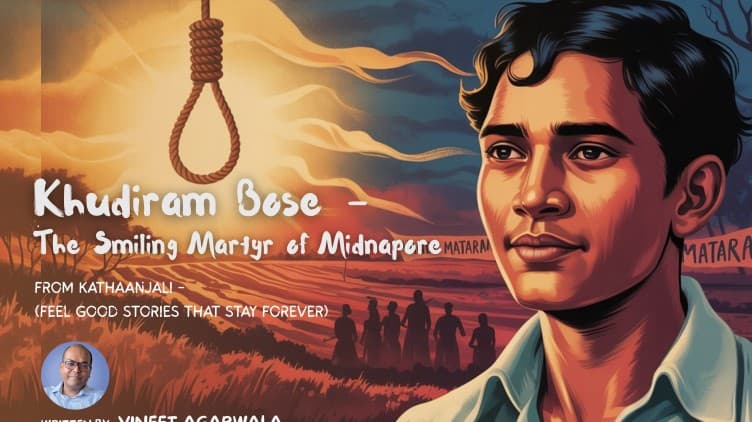
Khudiram Bose – The Smiling Martyr of Midnapore
KathaAnjali is my personal archive of stories that hit deeper than advice.
Short, real, and rooted in Indian mythology, history, sport, and everyday life — each one is picked to make you pause, feel, or see differently
Some teach. Some heal. All stay.
In the heart of Midnapore, among fields where the soil is red and the air smells of freedom, a boy was born in 1889, Khudiram Bose. He was just another village child, barefoot and bright-eyed, until destiny called him to a place in history.
Orphaned young, Khudiram’s childhood could have been a story of loss. But his eldest sister Aparupa raised him with care, sending him first to Hamilton High School in Tamluk, and later to Midnapore Collegiate School. It was here that Khudiram’s spirit met the fire of revolution. The Swadeshi movement had reached Midnapore, and the boy listened wide-eyed to leaders like Aurobindo Ghosh and Sister Nivedita, who came to inspire students.
The Seeds of Rebellion
Khudiram was not a child who could stay quiet. He distributed leaflets calling for Swaraj, joined processions shouting “Bande Mataram!”, and trained secretly with members of the Anushilan Samiti.
By the time he was 17, his resolve was stronger than most men double his age. While other boys worried about examinations, Khudiram carried bombs and dreams of freedom.
Kingsford – The Tyrant Magistrate
The focus of his fury was Magistrate Douglas Kingsford of Muzaffarpur. Kingsford was feared across Bengal. He handed down cruel punishments to nationalists, sentenced youth to long prison terms for simply shouting slogans, and ordered public floggings to break the spirit of Swadeshi workers. His name was whispered with anger in tea shops, schools, and households
To Khudiram, Kingsford became the very face of British cruelty. And he believed that striking him down would send a message to all of India: the youth will not bow.
The Night of the Bomb
On 30 April 1908, Khudiram and his comrade Prafulla Chaki waited outside the European Club in Muzaffarpur. Disguised as schoolboys, they stood by the roadside, clutching bombs wrapped in cloth. Their hearts pounded, not with fear, but with fire.
At last, a carriage rolled by. Believing Kingsford sat inside, Khudiram hurled the bomb with the unflinching hand of a 17-year-old patriot. The explosion tore through the night. But fate played its cruel trick — the carriage carried not Kingsford, but two Englishwomen. They died, while Kingsford escaped.
The empire branded it a crime. But in every corner of Bengal, whispers spread: “A boy from Midnapore dared to strike!”
Capture and Trial
Khudiram fled for miles, dusty, hungry, barefoot. At a small tea stall, constables grew suspicious of the tired youth with fire still in his eyes. He was arrested with maps, weapons, and his courage intact.
At trial, he stood calm. The judges thundered, the lawyers argued, but the boy listened silently, sometimes smiling faintly. The sentence was inevitable — death by hanging.
The Eve of the Noose
On the night of 10 August 1908, Muzaffarpur jail fell silent. While the world slept, Khudiram lay peacefully on his cot, as though it were just another evening. The jailers whispered, amazed at his composure. At dawn, he bathed, prayed quietly, and asked for water.
Then came the moment. With steady steps, Khudiram walked to the hanging platform. His head was held high, his face radiant, and on his lips — a smile. The rope was tightened, the crowd outside sobbed, yet Khudiram remained calm.
At just 18 years old, he embraced death as if it were destiny.
The Song of Immortality
Bengal could not contain its grief. But grief turned into song. Poet Prafulla Chandra Roy penned a ballad that swept through villages and cities alike:
“একবার বিদায় দে মা ঘুরে আসি,
হাসি হাসি পরব ফাঁসি, দেখবে ভারতবাসী…”
(“Bid me farewell once, Mother, I shall return.
Smiling, I will embrace the noose, and all of India shall witness it.”)
This song became more than music — it was Khudiram’s spirit turned into melody. Farmers sang it in fields, students hummed it in classNamerooms, and mothers wept as they rocked their children to sleep with its lines. It became a hymn of sacrifice, a war cry of youth, a mother’s eternal farewell.
The Legend Lives On
Khudiram Bose did not live to see 19, yet his death lit a torch for millions. His courage made others rise, his sacrifice strengthened the Swadeshi movement, and his smile at the noose became the face of youthful rebellion.
In Midnapore, people still say: He was not just a boy. He was a spark that became a flame.
A flame that burned in 1908, and still burns in the heart of a free India.
If this story stirred something in you — drop a note.
Need your encouragement...
If you have a story, share it…